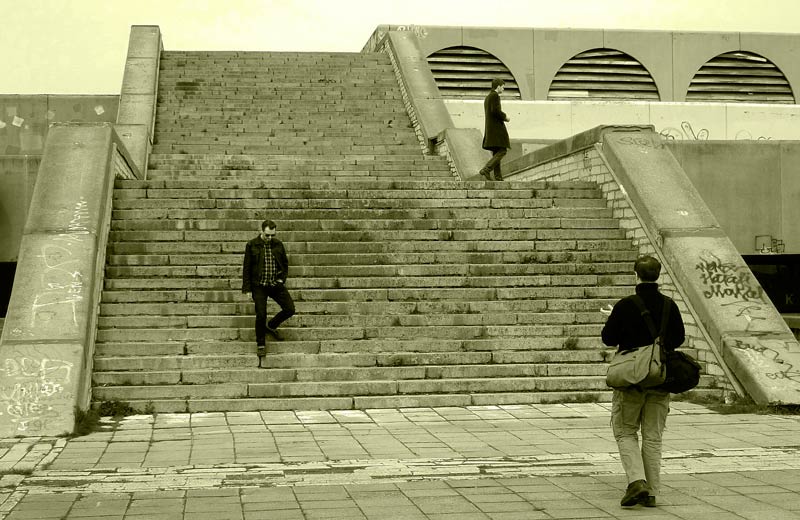
Istanbul soundwalks

On a recent visit to Istanbul I recorded several ’soundwalks’ through the cityscape. The recordings were made with a discreet pair of self-made binaural mics (panasonic wm-61a capsules) on a Sony PCM-D50. What becomes clear is that moving through space (as opposed to a stationary recording position) reveals just how diverse the spaces are in Istanbul). These walks were done as a casual pace, occasionally pausing to highlight particular sounds.

Galata Bridge and market tunnel

Spice Bazaar

Santral Istanbul, former power station ambience

Sounds of the Istanbul Biennial

Posted in location / site, mp3 / sound recordings | Tagged , , , , , | 1 Comment

new maps of time, prague / kladno

New Maps of Time
sound workshop Praha / Kladno Czech Republic
‘New Maps of Time’ is a project and workshop about mapping architectural and urban spaces using sound as a means to express actions within a space. read more…

Workshop Dates: 9-13th October 2009

Festival Dates: 10-16th October
in collaboration with FAMU, Skolska28, Open EYE project, Four Days in Motion festival, Biennial Vesitges of Industry

online: Radio Aporee Maps | Prague Favourite sounds

Site-specific sound actions:

Museum of former Sewage Plant – Piece for 10 underground channels:

Audio clip: Adobe Flash Player (version 9 or above) is required to play this audio clip. Download the latest version here. You also need to have JavaScript enabled in your browser.

Passage way in central Prague – Komedie Pasaz action with multiple mics:

Audio clip: Adobe Flash Player (version 9 or above) is required to play this audio clip. Download the latest version here. You also need to have JavaScript enabled in your browser.

Stromovka Park in Prague – Clapping action with multiple mics:

Audio clip: Adobe Flash Player (version 9 or above) is required to play this audio clip. Download the latest version here. You also need to have JavaScript enabled in your browser.

Video gallery on Vimeo

http://www.vimeo.com/7263868 http://www.vimeo.com/7281015
Posted in moving image, mp3 / sound recordings, project / workshop | Tagged , , , , , , , , | 1 Comment

new maps of time

exploring subjectivity and territory through sound, bridging acoustic processes with social and digital communication…

new_maps_banner2

Concept

‘New Maps of Time’ is a project and workshop about mapping spaces (mental, architectural and natural) using sound as a means to express actions within a space. The project process works with the basic understanding that artistic creativity can be a ritual by which we live out and  share the subjectivity of our own experiences. This inherent subjectivity must be  understood not only as an intellectual notion but through means of participatory activity on  different levels of personal, collaborative (between artists) and contextual actions (interventions in a space). The emphasis here is on subjectivity as articulated through direct experience of social intervention over the mediated representational forms of listening we are used to (“music” and “entertainment” of mass media).

Sound, as perceived by one of our primary senses hearing, is one of the best ways in which to explore the subjectivity of personal and collective experience and to test our own creative abilities. By using sound we develop means to map both space and social relations with our own cognitive process. In order to refine these cognitive maps we introduce constraints such as activities, materials, durations and the physical dimensions of the surrounding build environment. These constraints are the boundaries by which we can reference our own activities for interpretation and discussion to help further refine the activities.

In addition, we employ more objective external references (commonly known as recorded media) to add to the mix. The plethora of digital media recording devices offer a set of tools from which to develop an array audio-visual narratives for sharing on the local level and throughout any network these devices may be connected. Both processes, the cognitive and the mediated aim to increase the level at which we find recursive modes of information exchange integrated with the artistic working method.

Process Plan

The project involves spending a few days in and around the city, mapping various spaces and locations (parks, public squares, roof tops, industrial buildings etc.) through sound by using simple objects (glass jars, plates, wires, found objects etc…). One possibility is to use the same set of objects, but play them in different spaces. I  would like to work with a small team of students or local artists to help play these objects as a sort of free-form ensemble who gets to develop their abilities through the activities of the project. These participants can be local artists from abroad. I will record these actions and keep a record of the times and places where they took place (and make short films from video recordings as well).

The actions will involve generating acoustic sounds and patterns from the objects we have and/or find in the space to activate each location. Working together we will explore the balance between our gestures and movements to create sounds and the intelligibility by which we communicate through sounds (this has been thoroughly explored in various workshops. See the documentation from the Sound as Space, Sound as Language workshop developed with Patrick McGinley and Maksims Shentelevs or the Revenant sound project.

At the end of each action the working group would evaluate their experiences in a short discussion session as well as by listening to or watching the recordings. A selection of the recordings would be made and edited for the potentially use in the final performance lecture. The sound recordings would also be uploaded on the internet to Radio Aporee Maps which gives an overview from areal satellite maps of the different locations.

Performance/Lecture

The final presentation phase would be a “New Maps of Time” performance/lecture on the “sound mapping” process using the various materials collected and edited during the  residency including sounds, video, website, Radio Aporee, and even the objects used. This mix of material offers a representative experience of the workshop as compressed time, a nonlinear narrative with which to engage the public. As much as possible, the presentation space itself would be transformed into an instrument, a hollow body to enter and and be transported to the spaces and shared experiences of the working group from the previous weeks.

This workshop also will give a basic overview on both technical and artistic processes using sound, video and web based media.

———-
Workshops locations:

New Maps of Time workshop, Prague/Kladno Czech Republic (10.2009)

New Maps of Time workshop, Istanbul Turkey (2.2010)

Posted in location / site, project / workshop | Tagged , , , , , , , , , , , | Leave a comment

EAR ROOM #4

EAR ROOM | re-sounding dialogues across the globe

# 4 Online now :: John Grzinich

~~~~

Ear Room, an ONLINE publication for developing critical DISCOURSE and debate
on the creative, and EXPLORATIVE use of SOUND in artistic PRACTICE.

~~~

WHERE… http://earroom.wordpress.com/

Posted in text / writings, web link | Tagged , | Leave a comment

active crossover (bristol + hull uk)

Active Crossover is an installation and exchange project by UK sound artist Simon Whetham. I will be performing at the opening and giving a workshop with Maksims Shentelevs. See the information below for details. Following that we perform in Hull for Seeds and Bridges, the concert series organized by Jez Riley French.

—–

Simon Whetham: Active Crossover
Arnolfini Dark Studio
16 Narrow Quay
Bristol
BS1 4QA

Thursday 1st – Sunday 18th, October 2009
Open 10.00am – 6.00pm Tuesday – Sunday

A sound installation utilizing two sonic chambers, but allowing for controlled sound-bleed between spaces, it features an immersive composition created while Simon was artist-in-residence at the Polymer Factory Culturehouse (in Tallinn, Estonia) juxtaposed with pieces by artists Simon collaborated, performed and worked with during the residency.

The opening night of the exhibition will feature performances from John Grzinich (EE), Maksims Shentelevs (LV), Jez Riley French (UK) and Simon himself. The closing night will also feature performances, where Simon will be joined by Douglas Benford and Iris Garrelfs of Sprawl, and a number of invited local artists.

To coincide with the exhibition John and Simon will also run listening and recording workshops from the 26th September 2009.

—–

seeds_and_bridges01

Seeds and Bridges: Event One

John Grzinich (USA / Estonia)
Max Shentelevs (Latvia)
Simon Whetham (UK)

Saturday October 3rd @ RED Gallery, Ossbourne Street, Hull (behind Primark)

7pm – FREE to all !

Posted in event / performance, project / workshop | Tagged , , , , , , , | Leave a comment

building contact microphones

Since a number of people have asked about building contact microphones, particularly from my youtube videos, I’m posting a very brief tutorial here regarding my own experience. Since I have no need to build any contact mics at the moment I’ll only talk a bit about the components. There are other web pages here and here that elaborate on the building process.

Contact microphones are actually piezoelectric transducers and are mostly used for producing sound as buzzers, beepers and small speakers in electronic devices. If the signal is reversed using a piezo transducer as a mic, you’re actually picking up vibrations and having it produce voltage. Connecting this to a recording device or mixer allows you to hear the vibrations as sound. Piezo transducers come in all shapes and sizes, the most common ones ranging from 25-50 mm in diameter. They can be ordered from electronics components distributors such as Maplin in the UK or DigiKey in the US. As for what kind of disc to buy this is a question of great debate, but I generally stick to mid sized discs of 30-40mm with a resonant frequency of 1khz. Best of all they are cheap, usually 50 cents or so.

piezo sizes
As for building contact mics, the process is fairly simple. A soldering iron and raw solder is needed. Some flux paste is helpful for getting the wires to stick more firmly. As you can see some piezos come with leads already attached. All you need to do is connect then to a wire and the appropriate plug. The center circle of the disc is the ceramic piezo element (what produces voltage). The ‘hot’ lead needs to be connected to this and the ground needs to be connected to the outer metal part.

plugs
What plug you use depends on what kind of device you use for the signal. Most likely you will connect your contact mic to a mixer or directly to a recording device such as a flash recorder (Sony PCM-D50, Edirol R-9, Zoom H4 etc.) or Minidisc. I often work in the field and connect my contact mics as a stereo pair to a flash recorder with a 1/8″ mini-jack.

piezo disc
To make a stereo pair, simply solder up two single discs and attach the ‘hot’ leads to the two center signal leads on the mini-jack plug. Be sure to insulate any contact to avoid shorting the signal.

mini-jack plug
Finalizing your contact mics is an important step. Piezo transducers tend to be fragile. If the ceramic crystal is damaged in any way you’ll immediately know it. At the very minimum its good to put some kind of glue over the back of the disc to protect the crystal. I sometimes put the felt furniture pads that are used on chair leg bottoms over the crystal to protect it then I cover the whole disc with electrical tape. I also glue a thin piece of wood to the front side with epoxy. This is to make sure the disc does not bend and crack. The wood also “softens” the sound as piezos tend to have a sharp metallic sound (since they are actually made of metal). Some people also coat their mics with something like plastidip which makes a nice clean protective finish.

finished contact microphones
Another reason to protect the piezos is because they tend to work better when a bit of pressure is applied. The sensitivity increases and you tend to get much better bass response. With the felt furniture pad backing and wood front I’m not afraid of bending the disc or crushing the ceramic part when using clamps or clips. Its also handy to use something like blue-tack to make a firm connection to the surface of what you are trying to record.

clips and clamps
It is good to carry around a number of different clips and clamps for the materials and situations you might encounter. Most of these are cheap and lightweight and can be found from most building supply stores.

FEL microphone amplifier
Lastly, this is a device I often use when recording with my contact mics. The FEL Microphone Amplifier is small, runs from a 9V battery and can boost a stereo signal up to 50dB. This really helps when the source is more quiet or you want to pull some bass out. Most of the time I need to boost the signal about +15-30dB, but occasionally you need more.

For examples of my recordings using contact mics check the posts with the tag *contact mics*

The two digital recording devices used are the Edirol R-09 and a Sony PCM-D50. For some some microphone tests and personal commentary on these check here and here.

Hopefully this helps anyone who is interested in working more with contact mics. Most importantly, remember there are no fixed rules about the best ways to use contact mics and it a matter of continuous experimentation. I will update this page if more questions or info comes in.

Posted in technical info, web link | Tagged , , , , , | 6 Comments

mutopia

Over the past year I’ve been developing a workshop concept that involves a whole range of ideas. The workshop known as “Mutopia” started somewhat accidentally last year at MoKS summer symposium AVAMAA when I decided to collaborate with Tero Nauha, a researcher and performance artist from Finland. We both had our own workshop plans but combined them to form something new. The outcome was more than we expected and therein was one of the core ideas, to create something that is collaborative, all inclusive and provides conditions for open exchanges. What follows is a general frame for the efforts of the participants to be coordinated. As I describe on the new Vimeo page:

Mutopia is a process oriented workshop environment that explores collaboration, collective creativity and open forms of authorship. This is done through social and environmental research, exercises, games and the use of mixed artistic media such as sound, collage, text, performance etc…

The videos here are composted aspects of the process but should not necessarily be considered the only “results”. The outcome is more the subjective experiences of the individuals who participate and contribute.

The collaborative aspect is essential. I’m trying not to steer a particular direction for the group and avoid the format and product mentality. The videos came out because of the possibility to layer the different processes into some composite form but other outcomes are there. Some of the texts hold well on their own as well as the readings of the texts. This is the importance of understanding the strength of subjectivity, that each participant sees their own contribution in the whole, where collective authorship is the prime motivation once people open up and get inspired. the narratives come directly out of the process and in fact are multiple.

I’m interested in being much more of a guide for the processes and mediator of the ideas than an artist who shapes the world around me to “fit” certain ideas. With each step of the process we break to desire to determine goals allowing indeterminacy to take its course.

http://www.vimeo.com/6252332
http://www.vimeo.com/6243462

Mutopia 1 – AVAMAA MoKS Summer art syposium 2008
Mutopia 2 – X-OP symposium, Macao Portual April 2009
Mutopia 3 – AVAMAA MoKS Summer art syposium 2009
Mutopia 4 – Polymer Culture Factory, Tallinn – 12.2009
Mutopia 5 – Jelgava University, Latvia – 12.2009

Posted in moving image, project / workshop | Tagged , , , , , , , , , | 1 Comment

ear room

EAR ROOM | re-sounding dialogues across the globe

First edition online now :: Jez Riley French.
~~~~
Ear Room, an ONLINE publication for developing critical DISCOURSE and debate
on the creative, and EXPLORATIVE use of SOUND in artistic PRACTICE.
~~~
WHEN… on the FIRST of every month (August launch is a special double
edition on the 1st and 15th).
~~
WHERE… http://earroom.wordpress.com/ear

via… mark peter wright

Posted in text / writings, web link | Tagged , , | Leave a comment

tape, wind and wire soundmix #1

http://www.vimeo.com/5703808

New video up. This is a straight forward sound mix made in my backyard using both live mics and contact mics. No post-processing or composing was done. A higher quality version is available on my Vimeo page. The video was from hand held material recorded on a panasonic digital camera.

Posted in location / site, moving image | Tagged , , , , , , , , | 1 Comment

location sound films @ liquid architecture

la10iceblock

The Location Sound Films installation will be exhibited during the Liquid Architecture festival in Australia. The festival is one of the largest events of its kind showcasing sound related art and experimental music in seven cities across the continent.

Details for the exhibition is as follows:

Alan Lamb | Rosalind Hall | Dale Gorfinkel | Peter Blamey | John Grzinich
11.07.09 – 25.07.09
Opening: Saturday 11 July 3 – 5pm
West Space Gallery – Melbourne

Special thanks to Camilla Hannan for helping set this up and Eamon Sprod for continued support.

Posted in event / performance, moving image | Tagged , , , , , , | Leave a comment

formica aquilonia

Formica aquilonia or Red Wood Ant is a species of ant commonly found in the area where I live. The ant colonies are easily recognizable by the large mounds that they build out of debris from the pine forests they inhabit. The mounds also tend to be clustered together. I’m not sure what is the relation between the mounds, but the activity between them can be so frequent that “ant highways” or noticeable paths form on the forest floor. Ants are in the Family Formicidae meaning they give off formic acid when defending a territory through biting or spraying. Formic acid happens to be highly corrosive to some piezo transducer materials. This I know because one of the contact mics I used to record the ants was unprotected and went bad after about 15 seconds after I placed it on a mound.

The recording method here is something of an intervention and is not scientific in any way. If anything it is quite a provocation for the ants as I place the mics on the surface of the mound. They take it as a foreign object (which it is) and attack it. So the sound is a combination of biting, scratching and walking on the contact mics. To add some variation I used two different kinds of piezos and attached some thin brass wire to the discs. I do my very best not to harm the ants or their mounds especially since they are under a mild form of environmental protection due to threats from pollution.

contact microphone intervention with formica aqulonia – red wood ants (3:26)

Audio clip: Adobe Flash Player (version 9 or above) is required to play this audio clip. Download the latest version here. You also need to have JavaScript enabled in your browser.

and here is a video I made about these ants:

http://www.vimeo.com/5887482
Posted in location / site, mp3 / sound recordings | Tagged , , , , , , , , | 1 Comment

subterranean soviet silos

I finally managed to visit a curious location in a forest in south Estonia and discovered that it indeed was one of the former soviet nuclear missile silos. As I’ve seen, most missile bases were mobile launching pads for missiles that were stored on trucks in bunkers. In this location the missiles were actually stored vertically in silos. It is likely that these bases were armed right up until the time of Estonian re-independance in 1991 when the soviet army pulled out. As you can see in the photos the site is being excavated and will eventually be filled in (I assume). Not having much time, I only managed to record the sound of stones dropping into the water at the bottom. The silos were quite deep and very resonant as you can hear.

stones tossed into an abandoned soviet nuclear missile silo (2:13)

Audio clip: Adobe Flash Player (version 9 or above) is required to play this audio clip. Download the latest version here. You also need to have JavaScript enabled in your browser.

Posted in location / site, mp3 / sound recordings | Tagged , , , , , | Leave a comment